Multiplier Simulation and Factorization
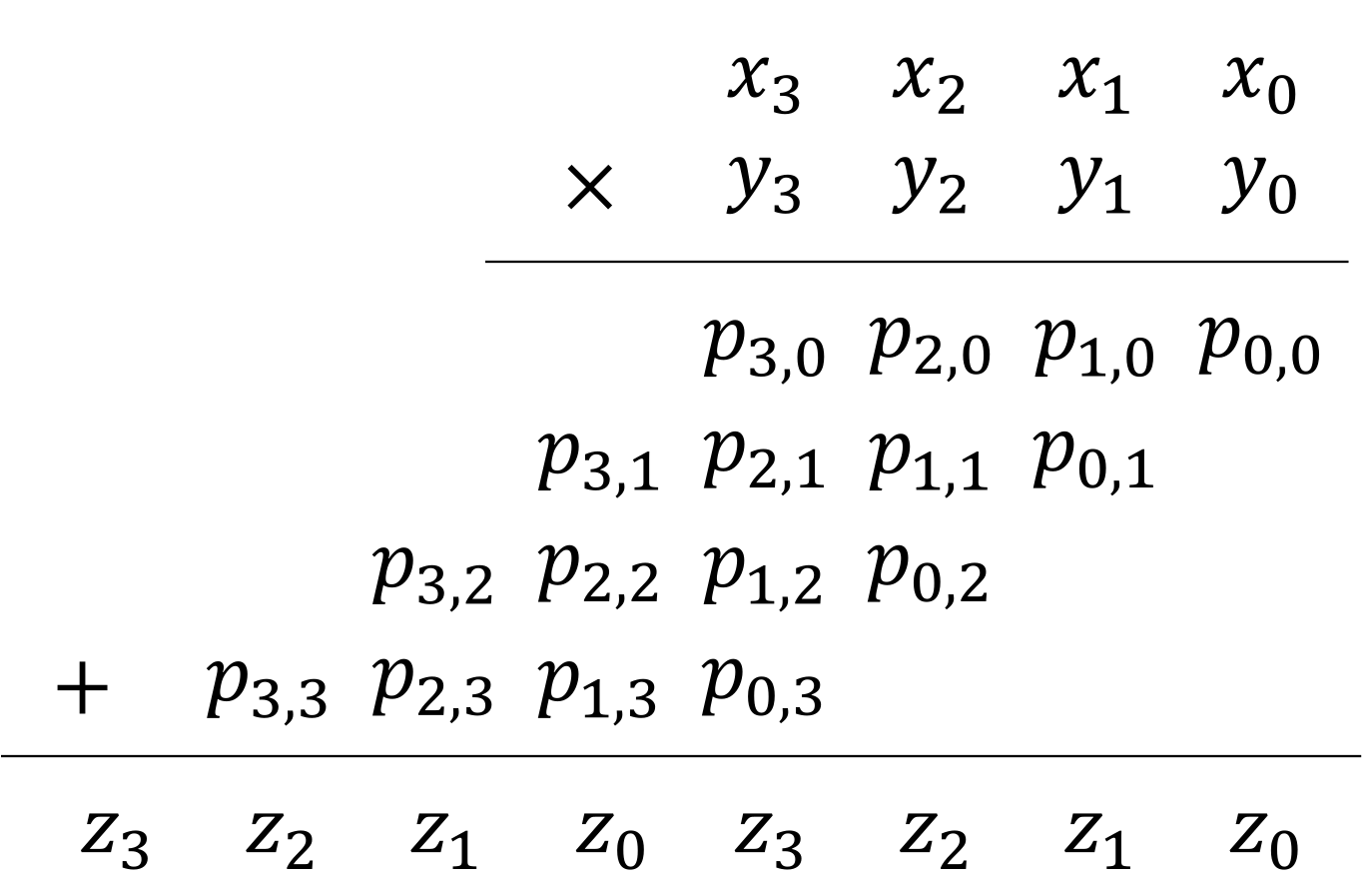
Multiplication of two integers can be performed using additions. In this section, we design a multiplier for two 4-bit integers using full adders. The figure below shows how two $x_3x_2x_1x_0$ and $y_3y_2y_1y_0$ are multiplied to obtain an 8-bit integer $z_7z_6z_5z_4z_3z_2z_1z_0$. In this figure, $p_{i,j}=x_iy_j$ ($0\leq i,j\leq 3$) and these partial products are summed to compute the final 8-bit result.
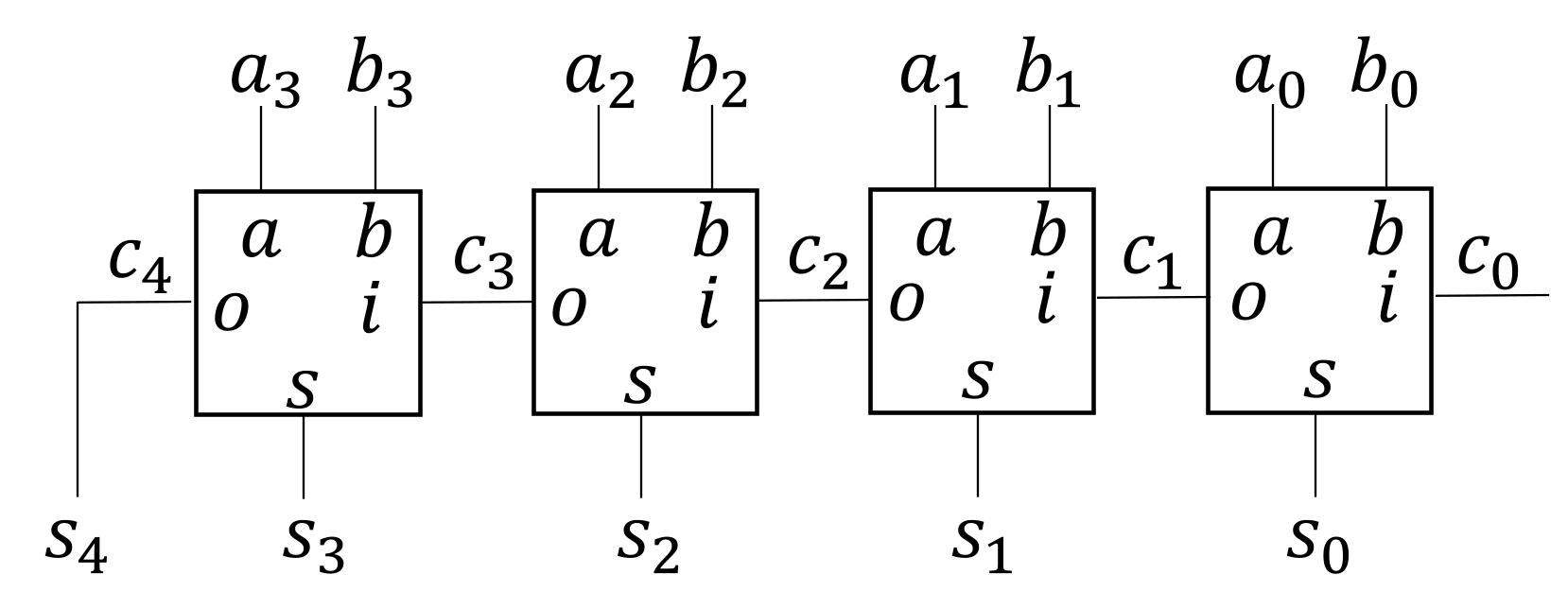
We use a 4-bit ripple-carry adder that computes the sum of two 4-bit integers $a_3a_2a_1a_0$ and $b_3b_2b_1b_0$ producing the 5-bit sum $z_4z_3z_2z_1z_0$. It consists of four full adders connected by a 5-bit carry wire $c_4c_3c_2c_1c_0$ that propagates carries.
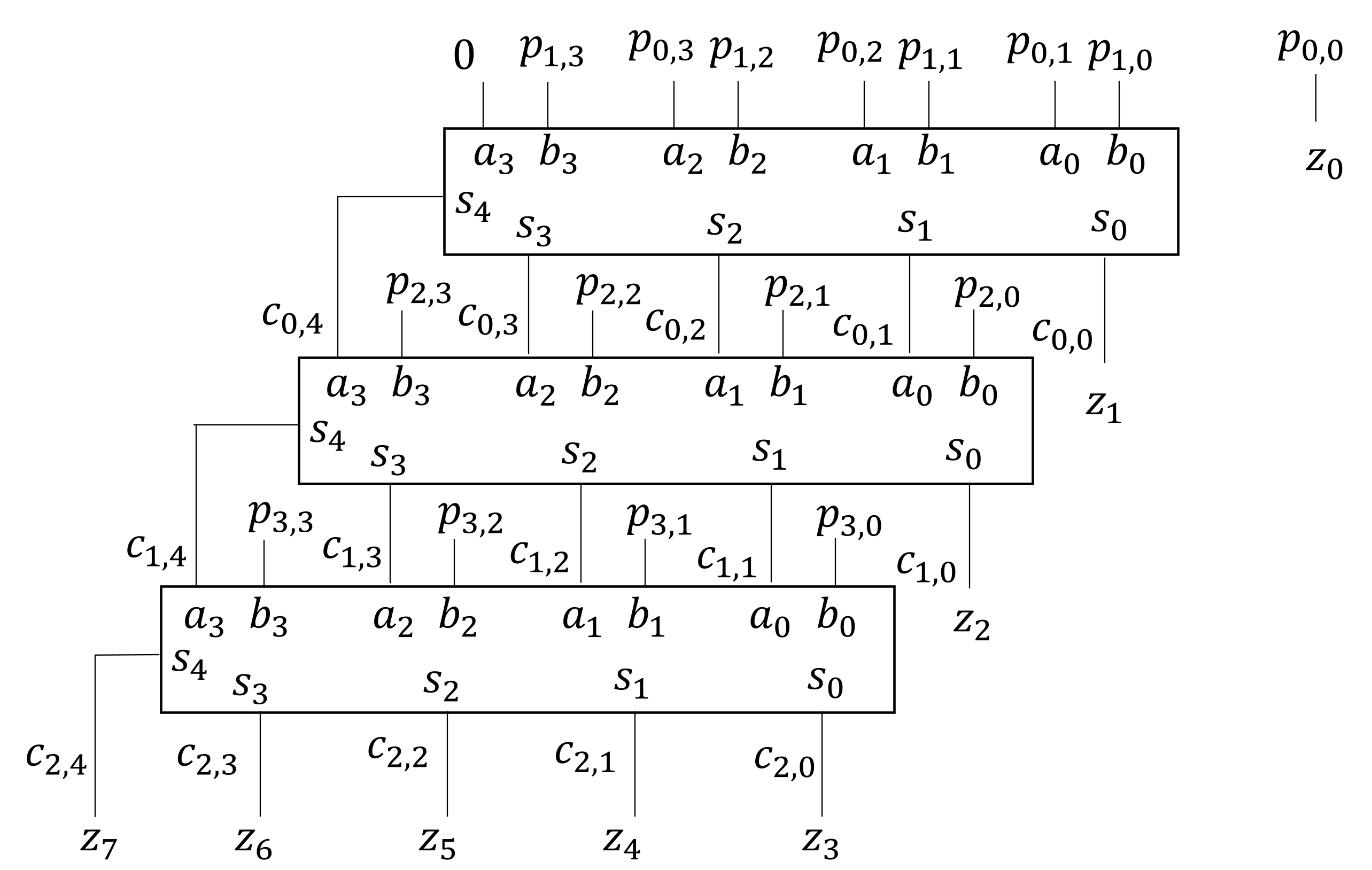
A 4-bit multiplier can be constructed using three 4-bit adders. They are connected by wires $c_{i,j}$ ($0\leq i\leq 2, 0\leq j\leq 3$) to propagate intermediate sum bits, as shown below:
QUBO formulation for multiplier
We will show QUBO formulation for simulating the N-bit multiplier. To do this, we implement functions that construct a full adder, an adder, and a multiplier.
Full adder
The following QUBO expression simulates a full adder with three input bits a, b, and i, and two output bits: carry-out o and sum s:
def fa(a, b, i, o, s):
    return ((a + b + i) - (2 * o + s) == 0)
The function fa returns an expression that enforces consistency between the input and output bits of a full adder. expr == 0 returns a QUBO expression whose minimum value is 0 exactly when expr == 0 holds, i.e., when the full adder is consistent.
Adder
Assume that lists a, b, and s represent integers. We assume that a and b each have N elements representing N-bit integers, while s has N + 1 elements representing an (N + 1)-bit integer. The following function adder returns a QUBO expression whose minimum value is 0 if and only if a + b == s holds. Because a, b, and s may be containers of different element types (binary variables, expressions, or integer constants), no explicit type annotation is needed — Python’s dynamic typing lets each call site pass whichever list or array it has:
def adder(a, b, s):
    N = len(a)
    c = qbpp.var(shape=N + 1)
    f = 0
    for j in range(N):
        f += fa(a[j], b[j], c[j], c[j + 1], s[j])
    ml = {c[0]: 0, c[N]: s[N]}
    return qbpp.replace(f, ml)
In this function, c is a vector of N + 1 variables used to connect the carry-out and carry-in signals of the fa blocks, forming an N-bit ripple-carry adder. qbpp.var(shape=N + 1) creates an auto-named array of N + 1 fresh binary variables (the name is generated internally so that repeated calls from different adder stages never collide). The final qbpp.replace(f, ml) pins c[0] to 0 (no carry-in) and binds c[N] to s[N] (the top bit of the sum is the final carry-out).
Multiplier
Assume that lists x, y, and z represent integers. We assume that x and y each have N elements and that z has 2 * N elements. The following function multiplier returns a QUBO expression whose minimum value is 0 if and only if x * y == z holds. As with adder, the caller may pass any combination of variable arrays, expression lists, or integer constants — Python’s dynamic typing handles the mixed element types transparently.
def multiplier(x, y, z):
    N = len(x)
    c = qbpp.var("c", shape=(N - 1, N + 1))

    f = 0

    for i in range(N - 1):
        b_vec = [x[i + 1] * y[j] for j in range(N)]

        if i == 0:
            a_vec = [x[0] * y[j + 1] for j in range(N - 1)] + [0]
        else:
            a_vec = [c[i - 1][j + 1] for j in range(N)]

        s_vec = [c[i][j] for j in range(N + 1)]
        f += adder(a_vec, b_vec, s_vec)

    f += (z[0] - x[0] * y[0] == 0)

    ml = {c[i][0]: z[i + 1] for i in range(N - 2)}
    ml.update({c[N - 2][i]: z[N + i - 1] for i in range(N + 1)})
    f = qbpp.replace(f, ml)
    f.simplify_as_binary()
    return f
This function uses an (N−1)×(N+1) matrix c of binary variables (created by qbpp.var("c", shape=(N - 1, N + 1))) to connect the N−1 adders of N bits. Each row c[i] carries the (N+1)-bit sum produced by the i-th adder stage, and that sum either feeds into the next adder stage as the a operand or is mapped to a bit of the final product z. Since each bit of z corresponds to one element of c, their correspondence is defined in the dict ml, and the replacements are performed in one pass with qbpp.replace(f, ml). The extra term z[0] - x[0] * y[0] == 0 accounts for the lowest bit of the product, which is not produced by any adder stage. The final call to f.simplify_as_binary() reduces the expression in place under the binary (0/1) rule (it modifies f and returns None).
PyQBPP program for factorization
Using the function multiplier, we can factor a composite integer into two factors. The following program constructs a 4-bit multiplier with
x: 4 binary variables,y: 4 binary variables,z: a list of constants[1, 1, 1, 1, 0, 0, 0, 1], representing the 8-bit integer10001111(143), and stores the resulting expression inf:
import pyqbpp as qbpp

def fa(a, b, i, o, s):
    return ((a + b + i) - (2 * o + s) == 0)

def adder(a, b, s):
    N = len(a)
    c = qbpp.var(shape=N + 1)
    f = 0
    for j in range(N):
        f += fa(a[j], b[j], c[j], c[j + 1], s[j])
    ml = {c[0]: 0, c[N]: s[N]}
    return qbpp.replace(f, ml)

def multiplier(x, y, z):
    N = len(x)
    c = qbpp.var("c", shape=(N - 1, N + 1))

    f = 0

    for i in range(N - 1):
        b_vec = [x[i + 1] * y[j] for j in range(N)]

        if i == 0:
            a_vec = [x[0] * y[j + 1] for j in range(N - 1)] + [0]
        else:
            a_vec = [c[i - 1][j + 1] for j in range(N)]

        s_vec = [c[i][j] for j in range(N + 1)]
        f += adder(a_vec, b_vec, s_vec)

    f += (z[0] - x[0] * y[0] == 0)

    ml = {c[i][0]: z[i + 1] for i in range(N - 2)}
    ml.update({c[N - 2][i]: z[N + i - 1] for i in range(N + 1)})
    f = qbpp.replace(f, ml)
    f.simplify_as_binary()
    return f

x = qbpp.var("x", shape=4)
y = qbpp.var("y", shape=4)
z = qbpp.array([1, 1, 1, 1, 0, 0, 0, 1])
f = multiplier(x, y, z)
f.simplify_as_binary()

solver = qbpp.EasySolver(f)
sol = solver.search(target_energy=0)

x_bits = "".join(str(sol(x[j])) for j in reversed(range(4)))
y_bits = "".join(str(sol(y[j])) for j in reversed(range(4)))
z_bits = "".join(str(z[j]) for j in reversed(range(8)))
print(f"{x_bits} * {y_bits} = {z_bits}")
The Easy Solver is executed on f with target_energy=0 (so the solver stops as soon as it finds a ground state where x * y == z holds), and the obtained solution is stored in sol. Each variable value is retrieved by calling sol(x[j]) / sol(y[j]), which returns the 0/1 assignment for that variable. The bits are concatenated in reverse order (most significant bit first) to form the printed binary literals:
1011 * 1101 = 10001111
This output indicates $11\times 13 = 143$, demonstrating the factorization result.