Subgraph Isomorphism Problem
Given two undirected graphs $G_H=(V_H,E_H)$ (the host graph) and $G_G=(V_G,E_G)$ (the guest graph), the subgraph isomorphism problem asks whether $G_H$ contains a subgraph that is isomorphic to $G_G$.
More formally, the goal is to find an injective mapping $\sigma:V_G\rightarrow V_H$ such that, for every edge $(u,v)\in E_G$, the pair $(\sigma(u),\sigma(v))$ is also an edge of the host graph, i.e., $(\sigma(u),\sigma(v))\in E_H$.
For example, consider the following host and guest graphs:
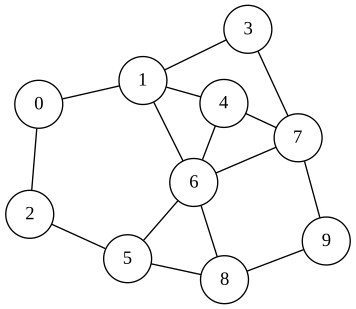
An example of the host graph $G_H=(V_H,E_H)$ with 10 nodes
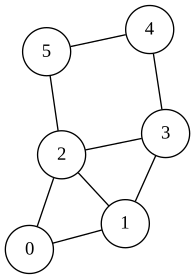
An example of the guest graph $G_G=(V_G,E_G)$ with 6 nodes
One solution $\sigma$ is:
| node $i$ in $G_G$ | 0 | 1 | 2 | 3 | 4 | 5 |
|---|---|---|---|---|---|---|
| node $\sigma(i)$ in $G_H$ | 1 | 4 | 6 | 7 | 9 | 8 |
This solution is visualized as follows:
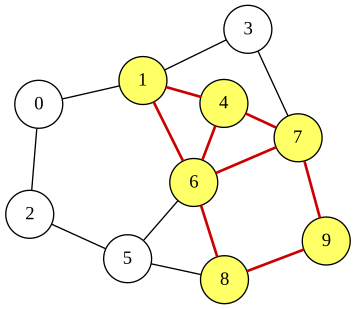
A solution to the subgraph isomorphism problem
QUBO formulation of the subgraph isomorphism problem
Assume that the guest graph $G_G=(V_G,E_G)$ has $m$ nodes labeled $0, 1, \ldots m-1$, and the host graph $G_H=(V_H,E_H)$ has $n$ nodes labeled $0, 1, \ldots n-1$. We introduce an $m\times n$ binary matrix $X=(x_{i,j})$ ($0\leq i\leq m-1, 0\leq j\leq n-1$) with $mn$ binary variables. This matrix represents an injective mapping $\sigma:V_G\rightarrow V_H$ such that $x_{i,j}=1$ if and only if $\sigma(i)=j$.
For example, the solution of the subgraph isomorphism problem can be represented by the following $6\times 10$ binary matrix:
| $i$ | $\sigma(i)$ | 0 | 1 | 2 | 3 | 4 | 5 | 6 | 7 | 8 | 9 |
|---|---|---|---|---|---|---|---|---|---|---|---|
| 0 | 1 | 0 | 1 | 0 | 0 | 0 | 0 | 0 | 0 | 0 | 0 |
| 1 | 4 | 0 | 0 | 0 | 0 | 1 | 0 | 0 | 0 | 0 | 0 |
| 2 | 6 | 0 | 0 | 0 | 0 | 0 | 0 | 1 | 0 | 0 | 0 |
| 3 | 7 | 0 | 0 | 0 | 0 | 0 | 0 | 0 | 1 | 0 | 0 |
| 4 | 9 | 0 | 0 | 0 | 0 | 0 | 0 | 0 | 0 | 0 | 1 |
| 5 | 8 | 0 | 0 | 0 | 0 | 0 | 0 | 0 | 0 | 1 | 0 |
Because $X$ represents an injective mapping, it must satisfy the following constraints:
- Row constraint: Each guest node is mapped to exactly one host node, i.e., the sum of each row is 1.
- Column constraint: Each host node is used by at most one guest node, i.e., the sum of each column is 0 or 1.
These can be combined into the following QUBO++-style constraint, which attains its minimum value when all constraints are satisfied:
\[\begin{aligned} \text{constraint} &= \sum_{i=0}^{m-1}\Bigl(\sum_{j=0}^{n-1}x_{i,j} = 1\Bigr)+\sum_{j=0}^{n-1}\Bigl(0\leq \sum_{i=0}^{m-1}x_{i,j} \leq 1\Bigr) \end{aligned}\]In QUBO form, we can express the same constraints as:
\[\begin{aligned} \text{constraint} &= \sum_{i=0}^{m-1}\Bigl(\sum_{j=0}^{n-1}x_{i,j} - 1\Bigr)^2+\sum_{j=0}^{n-1}\sum_{i=0}^{m-1}x_{i,j}\Bigl(\sum_{i=0}^{m-1}x_{i,j}-1\Bigr) \end{aligned}\]Next, we define the objective as the number of guest edges that are mapped to host edges:
\[\begin{aligned} \text{objective} &= \sum_{(u_G,v_G)\in E_G}\sum_{(u_H,v_H)\in E_H} (x_{u_G,u_H}x_{v_G,v_H}+x_{u_G,v_H}x_{v_G,u_H}) \end{aligned}\]Here, an undirected guest edge $(u_G,v_G)\in E_G$ can correspond to a host edge $(u_H,v_H)\in E_H$ in two symmetric ways:
- $(u_G, v_G)\mapsto (u_H,v_H)$
- $(u_G, v_G)\mapsto (v_H,u_H)$
Therefore, we include both quadratic terms $x_{u_G,u_H}x_{v_G,v_H}$ and $x_{u_G,v_H}x_{v_G,u_H}$.
Finally, we combine the objective and the constraint into a single QUBO expression:
\[\begin{aligned} f &= -\text{objective} + mn\times \text{constraint} \end{aligned}\]The penalty coefficient $mn$ is chosen so that satisfying the constraints is prioritized over improving the objective. The best possible value of $f$ is attained when the constraint term is zero and the objective equals the number of guest edges.
PyQBPP program for the subgraph isomorphism problem
Based on the QUBO formulation above, the following PyQBPP program solves the subgraph isomorphism problem for a guest graph with $M=6$ nodes and a host graph with $N=10$ nodes:
import pyqbpp as qbpp

N = 10
host = [
    (0, 1), (0, 2), (1, 3), (1, 4), (1, 6), (2, 5), (3, 7), (4, 6),
    (4, 7), (5, 6), (5, 8), (6, 8), (6, 7), (7, 9), (8, 9)]

M = 6
guest = [
    (0, 1), (0, 2), (1, 2), (1, 3), (2, 3), (2, 5), (3, 4), (4, 5)]

x = qbpp.var("x", shape=(M, N))

host_assigned = qbpp.vector_sum(x, axis=0)

constraint = qbpp.sum(qbpp.vector_sum(x, axis=1) == 1) + \
             qbpp.sum((0 <= host_assigned) & (qbpp.same <= 1))

objective = 0
for ug, vg in guest:
    for uh, vh in host:
        objective += x[ug][uh] * x[vg][vh] + x[ug][vh] * x[vg][uh]

f = -objective + constraint * (M * N)
f.simplify_as_binary()

solver = qbpp.EasySolver(f)
sol = solver.search(target_energy=-len(guest))

print(f"sol(x) = {sol(x)}")
print(f"sol(objective) = {sol(objective)}")
print(f"sol(constraint) = {sol(constraint)}")

guest_to_host = qbpp.onehot_to_int(sol(x), axis=1)
print(f"guest_to_host = {guest_to_host}")

host_to_guest = qbpp.onehot_to_int(sol(x), axis=0)
print(f"host_to_guest = {host_to_guest}")
The guest and host graphs are given as the edge lists guest and host, respectively. We define an $M\times N$ binary matrix x, and then construct the expressions constraint, objective, and f according to the formulation above.
An Easy Solver instance is created for f, and the target energy is set to $-|E_G|$ (the negative number of guest edges), which is the best possible value of -objective when all guest edges are mapped to host edges. The obtained solution is stored in sol. The values of x, objective, and constraint under sol are then printed.
Using the function qbpp.onehot_to_int(), the program also outputs the mappings from guest nodes to host nodes (guest_to_host, $\sigma$) and from host nodes to guest nodes (host_to_guest, $\sigma^{-1}$).
This program produces the following output:
sol(x) = {{0,1,0,0,0,0,0,0,0,0},{0,0,0,0,1,0,0,0,0,0},{0,0,0,0,0,0,1,0,0,0},{0,0,0,0,0,0,0,1,0,0},{0,0,0,0,0,0,0,0,0,1},{0,0,0,0,0,0,0,0,1,0}}
sol(objective) = 8
sol(constraint) = 0
guest_to_host = {1,4,6,7,9,8}
host_to_guest = {-1,0,-1,-1,1,-1,2,3,5,4}
The objective value equals the number of guest edges ($|E_G|=8$), and all constraints are satisfied (constraint = 0). Therefore, the program finds an optimal solution that corresponds to a valid subgraph isomorphism. Note that an entry of host_to_guest is -1 if the corresponding host node is not mapped from any guest node.
A more concise objective using einsum
The doubly-nested edge loop that builds objective can also be written with qbpp.einsum by representing each graph as a binary adjacency matrix instead of an edge list. With
A_G[a, b] = 1if ${a, b} \in E_G$ (one entry per undirected guest edge),A_H[c, d] = 1if ${c, d} \in E_H$ (one entry per undirected host edge),
the objective $\sum_{(u_G,v_G)\in E_G}\sum_{(u_H,v_H)\in E_H} (x_{u_G,u_H}x_{v_G,v_H}+x_{u_G,v_H}x_{v_G,u_H})$ becomes the sum of two einsum calls:
# Build adjacency matrices (one entry per undirected edge)
A_G = qbpp.array([0] * (M * M), shape=(M, M))
for u, v in guest:
    A_G[u][v] = 1
A_H = qbpp.array([0] * (N * N), shape=(N, N))
for u, v in host:
    A_H[u][v] = 1

# Σ_{a<b, c<d} A_G[a,b] * A_H[c,d] * (x[a,c]*x[b,d] + x[a,d]*x[b,c])
objective = qbpp.einsum("ab,cd,ac,bd->", A_G, A_H, x, x) \
          + qbpp.einsum("ab,cd,ad,bc->", A_G, A_H, x, x)
The subscript "ab,cd,ac,bd->" reads directly as $\sum_{a,b,c,d} A_G[a,b]\, A_H[c,d]\, x_{a,c}\, x_{b,d}$ — exactly the QAP-style contraction shown in the einsum documentation. The second call covers the symmetric mapping $(u_G, v_G) \mapsto (v_H, u_H)$ by swapping the host axes (ad,bc instead of ac,bd).
The resulting QUBO expression has the same simplified terms as the for-loop version, but the construction is much shorter and runs entirely inside the C++ backend with multithreading — avoiding the per-iteration Python ctypes overhead of the for-loop version. The trade-off is memory: edge-list construction is linear in $|E_G|+|E_H|$, while the adjacency representation is $\Theta(M^2 + N^2)$, so the loop version is preferable when the graphs are very sparse and very large.
Visualization using matplotlib
The following code visualizes the Subgraph Isomorphism solution on the host graph:
import matplotlib.pyplot as plt
import networkx as nx

G_host = nx.Graph()
G_host.add_nodes_from(range(N))
G_host.add_edges_from(host)
pos = nx.spring_layout(G_host, seed=42)

# Determine which host nodes are mapped
mapped = [0] * N
for i in range(M):
    for j in range(N):
        if sol(x[i][j]) == 1:
            mapped[j] = 1
colors = ["#e74c3c" if mapped[j] else "#d5dbdb" for j in range(N)]

# Highlight edges corresponding to guest edges
guest_adj = set()
for u, v in guest:
    guest_adj.add((u, v))
    guest_adj.add((v, u))

guest_to_host_map = {}
for i in range(M):
    for j in range(N):
        if sol(x[i][j]) == 1:
            guest_to_host_map[i] = j
host_to_guest_map = {v: k for k, v in guest_to_host_map.items()}

edge_colors = []
edge_widths = []
for u, v in host:
    gu = host_to_guest_map.get(u)
    gv = host_to_guest_map.get(v)
    if gu is not None and gv is not None and (gu, gv) in guest_adj:
        edge_colors.append("#e74c3c")
        edge_widths.append(2.5)
    else:
        edge_colors.append("#cccccc")
        edge_widths.append(1.0)

nx.draw(G_host, pos, with_labels=True, node_color=colors, node_size=400,
        font_size=9, edge_color=edge_colors, width=edge_widths)
plt.title("Subgraph Isomorphism")
plt.savefig("subgraph_isomorphism.png", dpi=150, bbox_inches="tight")
plt.show()
Mapped host nodes are shown in red, and edges corresponding to guest edges are highlighted.